Free Printable Wongoji Paper (Korean Manuscript Paper)
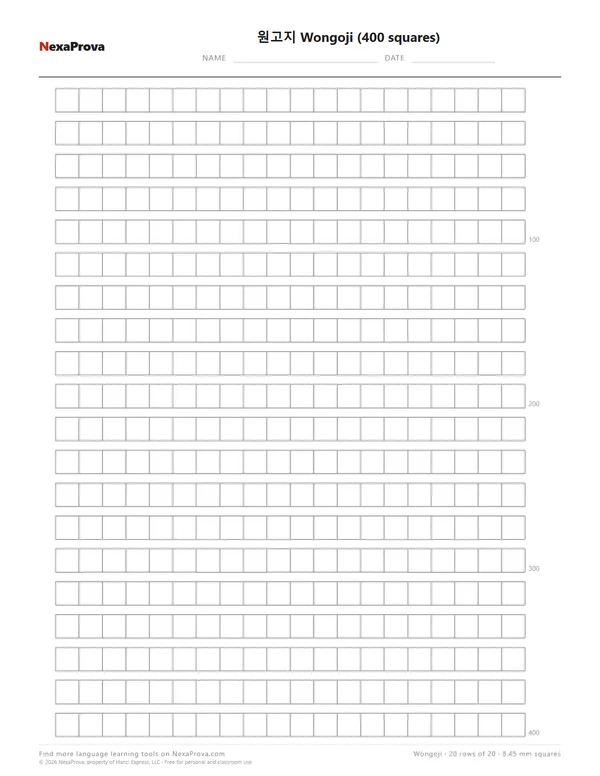
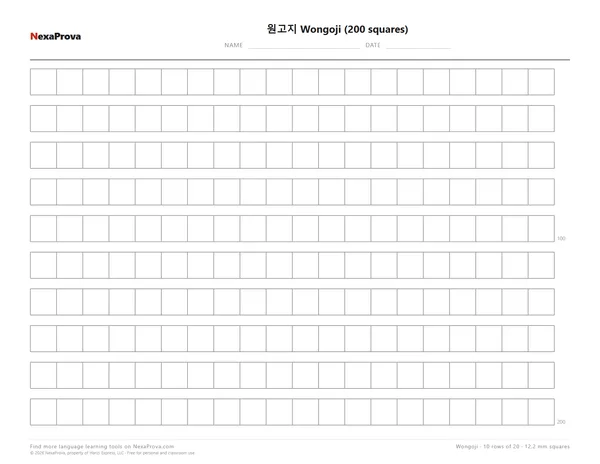
원고지 (wongoji) is Korean manuscript paper: a grid of squares with one syllable block in each. Download it free in two designs, 400 squares and 200 squares, each as a PDF for A4 and US Letter. Both have a narrow gap between rows for corrections and a running count every 100 squares, so you can see your length at a glance. They print in black and white. If neither fits, the generator below makes your own Korean writing paper, from wongoji in blue or green to Hangul practice squares with a line above each row for romanization. All of it is free, with no signup.
Wongoji paper: 400 or 200 squares
Korean writing paper generator: Hangul practice sheets and wongoji
Choose wongoji, plain squares or Hangul practice squares with a dashed center cross, in gray, blue or green, on A4 or US Letter. For practice and plain squares, set any size from 8 to 30 mm and add a line above each row for romanization or a meaning if you want one. The preview is the exact sheet you'll get, and "Print / Save as PDF" prints it or saves it as a PDF from the print dialog.
20 rows of 20 squares (400 squares), 8.75 mm squares, portrait.
Print / Save as PDFThe 400-square sheet has 20 rows of 20 squares on a portrait page, with squares of about 8.5 mm. One sheet holds a TOPIK question 53 answer. The 200-square sheet has 10 rows of 20 on a landscape page, with squares of about 12 mm, so there's more room for each syllable.
Rows run left to right. Between them is a narrow gap for corrections, and the count in the right margin marks every 100 squares, which on both sheets is every five rows. A line at the top takes your name and the date.
How to write on wongoji
Wongoji has fixed rules for spacing and punctuation. These are the standard ones.
- Leave the first square empty at the start of every paragraph.
- Write one syllable block per square, so 한국어 takes three squares.
- A space between words takes a square. But a row never starts with an empty square unless it starts a new paragraph, so if a space falls there, leave it out and begin the next word in the first square.
- A period or comma takes its own square, and the next word starts in the square right after it, with no space.
- After a question mark or an exclamation point, leave one square empty.
- Punctuation never starts a row. If the row is full when it comes, write it in the last square with the last syllable, or in the margin.
- Numbers go two digits to a square, so 2026 takes two squares.
- Latin letters go two to a square in lowercase. Each capital takes a square of its own.
- Quotation marks take a square of their own.
Because every space takes a square, the length you read off the margin includes your spaces.
Wongoji for TOPIK writing practice
TOPIK II writing asks for 200 to 300 characters in question 53 and 600 to 700 in question 54. One 400-square sheet holds a question 53 answer with 100 squares to spare, and two sheets hold a question 54 answer.
The count in the margin does the checking. For question 53, aim to finish between the 200 and 300 marks. For question 54, fill the first sheet and finish between the 200 and 300 marks on the second, which is 600 to 700 squares in all. If you finish question 54 before the 200 mark on your second sheet, you're short.
Printing wongoji paper
Print at 100% or "Actual size," not "Fit to page," so the squares keep their size. Pick the PDF that matches the paper in your printer: Letter in the US and Canada, A4 in most other places.
The sheets are free for personal and classroom use, so photocopy as many as your class needs. Each PDF also works as a wongoji template in a note app such as GoodNotes: import it and add a page whenever you need one.
Before wongoji: Hangul worksheets
Wongoji is Korean writing paper for whole texts. If you're still learning the letters, the Hangul worksheet generator prints stroke order sheets from single letters to whole words. The Hangul block worksheets practice how letters stack into the syllable blocks that go one to a square.
Frequently asked questions
Is this wongoji paper free?
Yes. Both PDFs and the generator are free, with no signup and no email address. The sheets are free for personal and classroom use, so you can photocopy them for a class.
What is wongoji?
원고지 (wongoji) is Korean manuscript paper, a grid of squares for handwritten text. You write one syllable block per square, left to right, and spaces and punctuation take squares too.
How do I write on wongoji paper?
Leave the first square of each paragraph empty, then write one syllable block per square. A space between words takes a square, but a row never starts with an empty square unless it starts a paragraph. A period or comma takes its own square, and the next word follows right after it.
Where does punctuation go at the end of a row?
Put it in the last square with the last syllable, or in the margin. Punctuation never starts a row. After a question mark or an exclamation point, leave one square empty before the next word.
How do I write numbers and English letters on wongoji?
Numbers go two digits to a square, so 2026 takes two squares. Lowercase letters also go two to a square, but each capital takes a square of its own.
How many wongoji sheets do I need for TOPIK writing?
You need one 400-square sheet for question 53, which asks for 200 to 300 characters, and two for question 54, which asks for 600 to 700. The count in the right margin shows your length every 100 squares.
What's the difference between the 400-square and 200-square sheets?
Both have rows of 20 squares. The 400 sheet has 20 rows on a portrait page, with squares of about 8.5 mm. The 200 sheet has 10 rows on a landscape page, so its squares are larger, about 12 mm.
Can I make my own Korean writing paper?
Yes. The generator on this page makes wongoji with 400 or 200 squares, plain squares or Hangul practice squares with a dashed center cross. Practice and plain squares can be any size from 8 to 30 mm, with an optional line above each row for romanization. Choose gray, blue or green lines and A4 or US Letter, then print the sheet or save it as a PDF from the print dialog. To keep a wongoji template in a note app such as GoodNotes, save the sheet as a PDF and import it.
Should I download A4 or US Letter?
Match the paper in your printer. In the US and Canada that's usually Letter, and elsewhere it's usually A4. Print at 100% or "Actual size" so the squares keep their size.