Free Printable Japanese Writing Paper
Genkō yōshi manuscript paper (also spelled genkouyoushi or genkoyoshi) is ready to download in 400 and 200 character versions, along with kanji practice squares (20, 15 and 10 mm) and furigana grids. Each one is a PDF in A4 and US Letter. If none of them fits, the generator makes a custom sheet with your own square size, grid style, line color and furigana lines. All of it is free, with no signup.
Genkō yōshi manuscript paper (原稿用紙)
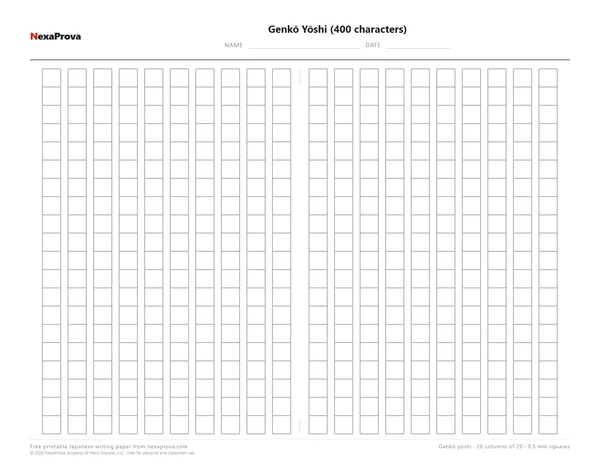
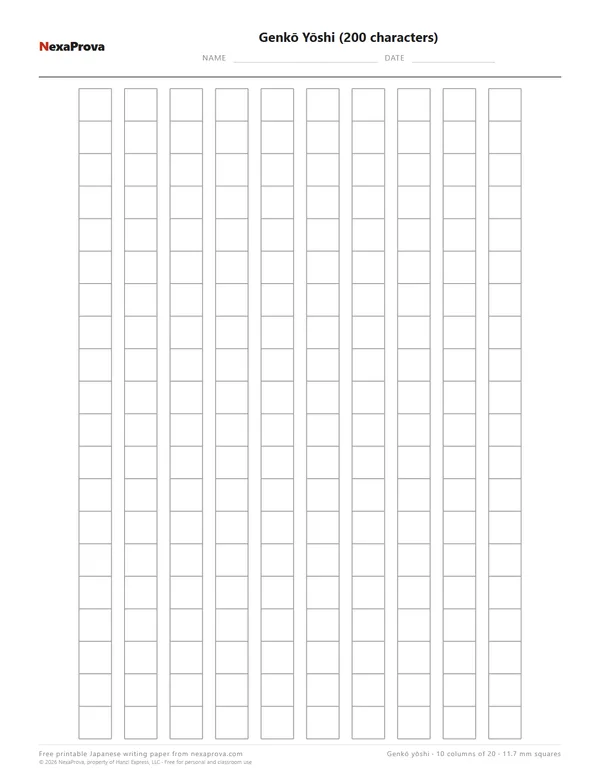
原稿用紙 (genkō yōshi, "manuscript paper") is the squared paper Japanese schools use for compositions and essays: columns of 20 squares, written top to bottom and right to left, with a gap between the columns for furigana. The 400-character sheet is the standard; the 200-character sheet has larger squares.
Kanji practice paper (漢字練習用紙)
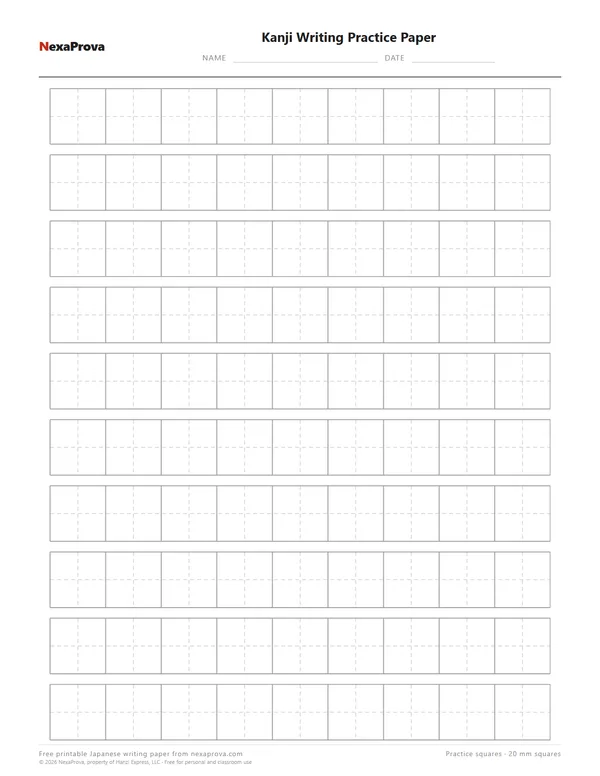
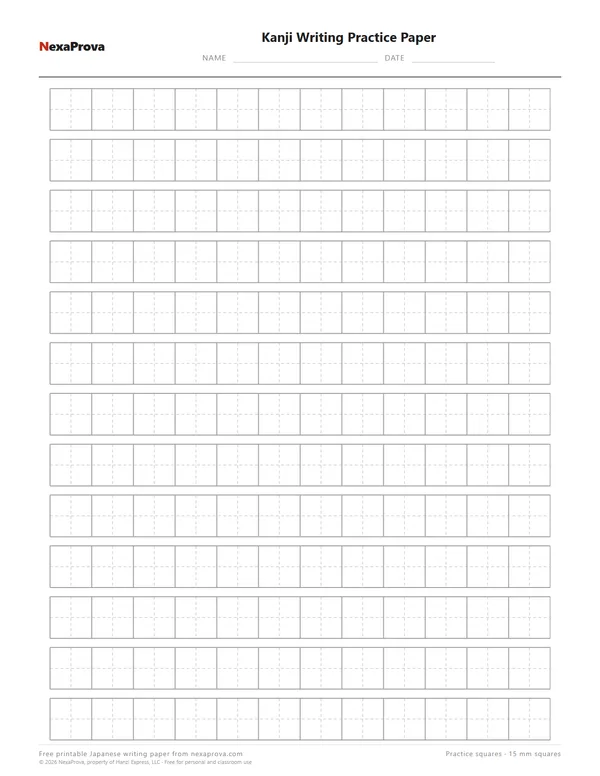
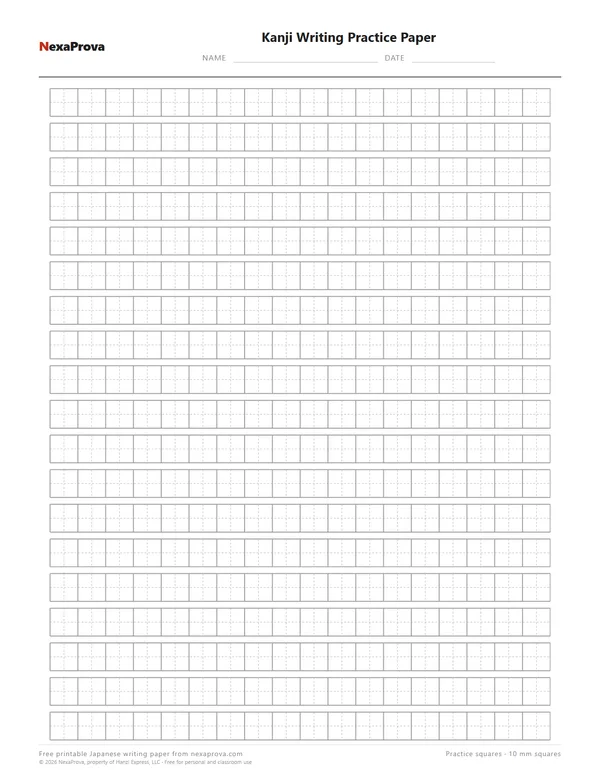
Rows of squares with a dashed cross in each, like the pages of a 漢字練習帳 (kanji practice notebook). The cross shows where the center of the character sits, which is what keeps kanji balanced and the same size.
Kanji practice paper with furigana lines
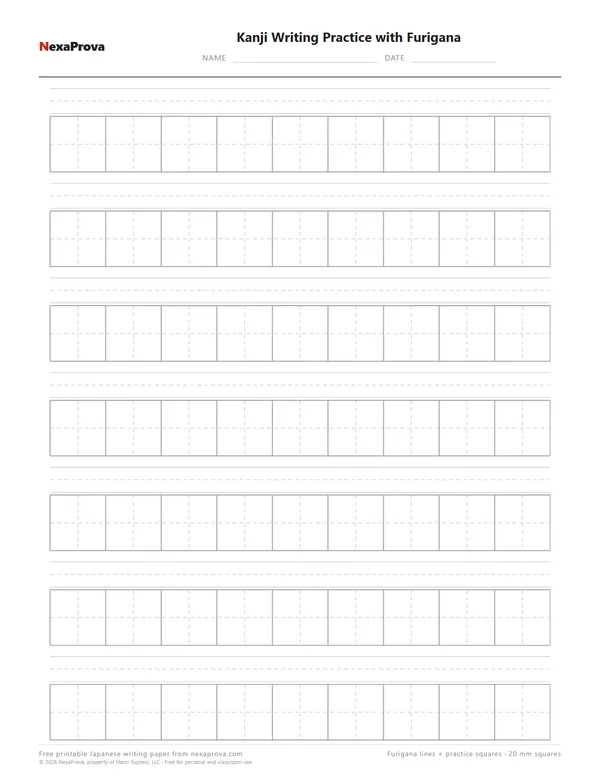
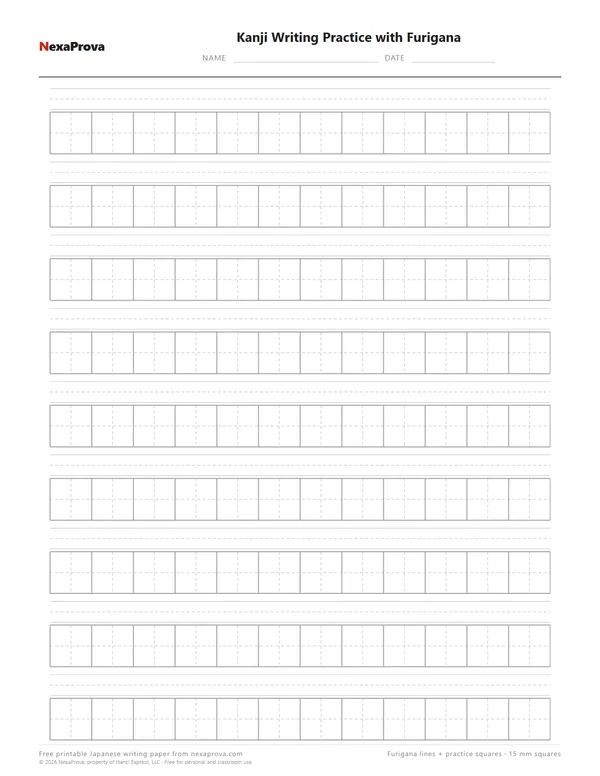
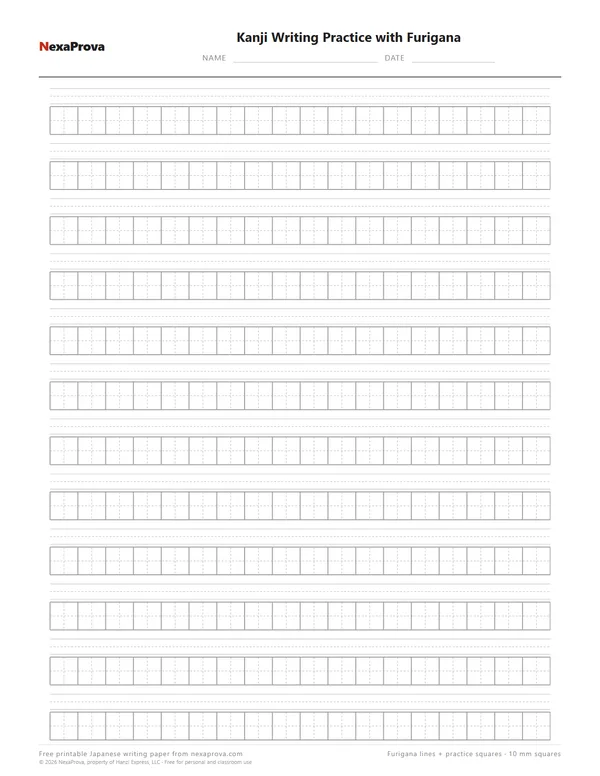
The same practice squares with a narrow strip above every row for the reading in hiragana, the way furigana sits above kanji in horizontal text.
Japanese writing paper generator: make your own sheet
Need a different square size, plain squares, blue lines or a 200-character sheet on Letter paper? Choose your options and print, or save the result as a PDF. The preview is the exact sheet you will get.
12 squares per row, 14 rows (168 squares) on one page.
Print / Save as PDFWhich Japanese writing paper should I use?
For learning to write kanji and kana, use the practice squares. The dashed cross in each square shows where the center of the character sits, so the parts of a kanji land in the right place and every character comes out the same size. Start with the 20 mm squares and move to 15 mm once your characters are steady; 10 mm is close to the size of ordinary handwriting and suits vocabulary lists and sentences.
For writing whole texts, use genkō yōshi. It is what Japanese students write compositions on, what Japanese language schools hand out for essay homework, and the format of the writing section in many classroom tests. Writing on it teaches the conventions of vertical Japanese text at the same time: one character per square, where the punctuation goes, how paragraphs start.
How to write on genkō yōshi
Genkō yōshi is read the way a Japanese book is: columns run from top to bottom, and the columns go from right to left, so the first column is the one on the right. The rules below are the ones taught in Japanese schools and expected in exams.
- Write the title in the first column, leaving the top two or three squares empty.
- Write your name in the second column, ending one square above the bottom. Leave a square between family name and given name.
- Start the text in the third column, and leave the first square of every new paragraph empty.
- Every character, kana, small kana (っ, ゃ, ゅ, ょ) and punctuation mark takes one square. Long vowel marks (ー) and dashes also take a square, drawn vertically.
- Full stops (。) and commas (、) sit in the top right corner of their square. A full stop, comma or closing bracket never starts a column: if it would, squeeze it into the last square of the previous column with the character already there.
- Opening quotation brackets (「) take a square and may start a column; closing brackets (」) follow the same rule as full stops.
- Numbers in vertical text are usually written in kanji (一, 二, 三), not Arabic digits.
A 400-character sheet is the standard unit of length: an assignment asking for “two sheets” means about 800 characters.
Writing furigana above kanji
In horizontal text, furigana (the small kana giving a kanji's reading) sits directly above the kanji. The furigana practice sheets add a strip above each row of squares for exactly that: write the kanji in the square and its reading in the strip above it. Teachers use these for vocabulary lists where students write the word, its reading and sometimes the meaning in one place, and learners use them to test themselves by covering one of the two.
Printing tips
Print at 100% or “Actual size”, not “Fit to page”, so the squares keep their stated size. Pick the PDF that matches the paper in your printer: A4 in most of the world, Letter in the US and Canada. The 400-character genkō yōshi prints in landscape; the printer picks that up from the PDF. Lines are light gray on purpose, so your pen stands out and photocopies stay clean.
Using the paper in GoodNotes, or as a notebook
Each PDF is a single page, so it works as a template in GoodNotes, Notability, Noteshelf or any PDF note app: import it, set it as a page template and add pages as you go. For a paper notebook, print a stack and bind or clip them, or print on both sides.
Need a worksheet with stroke order?
Blank paper is for free writing. If you want the stroke order of particular characters printed on the sheet, with tracing squares and blank ones to practice from memory, use the free kanji worksheet generator: pick any JLPT level or your own text and print the worksheet. For kana, the hiragana worksheets and katakana worksheets print the chart one row at a time.
Frequently asked questions
Is this Japanese writing paper free?
Yes. All 16 PDFs are free to download, with no signup and no email address. You can use them at home or in class and photocopy them as often as you need.
What is genkō yōshi?
原稿用紙 (genkō yōshi) means "manuscript paper". It is the squared paper used in Japan for handwritten compositions, essays and exam answers. The standard sheet has 400 squares in 20 columns of 20, written vertically from the top right, with one character, kana or punctuation mark per square.
How do I write on genkō yōshi?
Start at the top right and write down each column, moving left. Put the title on the first column, three squares down, and your name near the bottom of the second column. Begin the text on the third column and leave the first square of every paragraph empty. Every character, small kana and punctuation mark takes its own square, except that a full stop or comma that would land at the top of a column goes into the last square of the previous column, with the character already there.
What is the difference between the 400 and 200 character sheets?
Both have columns of 20 squares. The 400 sheet has 20 columns on a landscape page, which is the standard size for school compositions. The 200 sheet has 10 columns on a portrait page, so its squares are larger. It suits shorter pieces and younger students.
Can I make my own Japanese writing paper?
Yes. The generator on this page lets you choose genkō yōshi, practice squares with a center cross or plain squares, any square size from 8 to 30 mm, furigana lines, the line color and the paper size. Print it, or save it as a PDF from the print dialog.
Can I use this paper in GoodNotes?
Yes. Import the PDF into GoodNotes, Notability or another PDF note app as a template or notebook page, and duplicate the page as often as you need.
Should I download A4 or US Letter?
Match the paper in your printer. In the US and Canada that is usually Letter, and elsewhere it is usually A4. Print at 100% or "Actual size" so the squares keep their stated size.
Which paper is right for kids?
The 20 mm practice squares, 9 per row. The large furigana version adds a strip above each row for writing the reading. For compositions, the 200 character genkō yōshi has bigger squares than the standard 400 sheet.